
Some Things you might consider leaving in 2021
Back in 2009, a movie was released called Up in the Air, starring George Clooney. In the movie his character had a job that required him to travel around the country and basically live out of a suitcase. At one point, he describes his theory that everyone has a backpack they carry. Not an actual tangible backpack, but an emotional one. In this emotional backpack there are some things that are light and easy to carry, and others are heavier and may weigh us down. Now most of us have heard of this philosophy and probably used the term “emotional baggage” to describe it, but how do we accumulate it?
Well, every experience and relationship we have impacts us and helps shape how we see the world and how we see ourselves. Some of these things help us grow. They build us up and are profound. Some are things we don’t think about very often. And others have a different type of lasting impact. The impact they have may be painful, might be difficult to let go of, and may feel as though they it can’t be changed.
As we leave 2021 and begin a new year, we invite you to take this opportunity to sort through your own backpacks and decide what you want to leave behind and what you want to carry with you.
Some things you might consider leaving behind when sorting through your backpack are:
Putting others needs before your own – Thinking about others and caring about the needs of others is a wonderful quality. Regularly prioritizing others’ needs before your own can be problematic if the reason for this behavior is that you are worried about being rejected or losing the relationship. Your needs are just as important as someone else’s and recognizing the validity of your needs can start to change the relationship you have with yourself.
Relationships that are unfulfilling or leave you emotionally drained – Relationships are complex, and it is rare that relationships are truly 50/50 as more commonly, there is an ebb and flow or a give and take. But relationships that are more one sided or that regularly require a significant amount of time or energy may be one to take a closer look at. Ask yourself, what am I getting out of the relationship, are my needs getting met? If not, why not?
Not setting boundaries or assertively communicating your needs – In any of our relationships communication is critical. People are not mind readers, no matter how much we want them to be or think that they should be. Identifying why setting boundaries is challenging for you and learning assertive communication techniques can help enhance and strengthen relationships, including the one you have with yourself.
Goals you are not invested in – Goals in and of themselves can be positive, if they are goals we want for ourselves. Frequently, we develop goals in response to other people’s expectations or hopes for us and then convince ourselves this is what we want. Re-evaluating the goals you are working toward and understanding why you are working toward them allows you to check in with yourself to see what you really want for yourself.
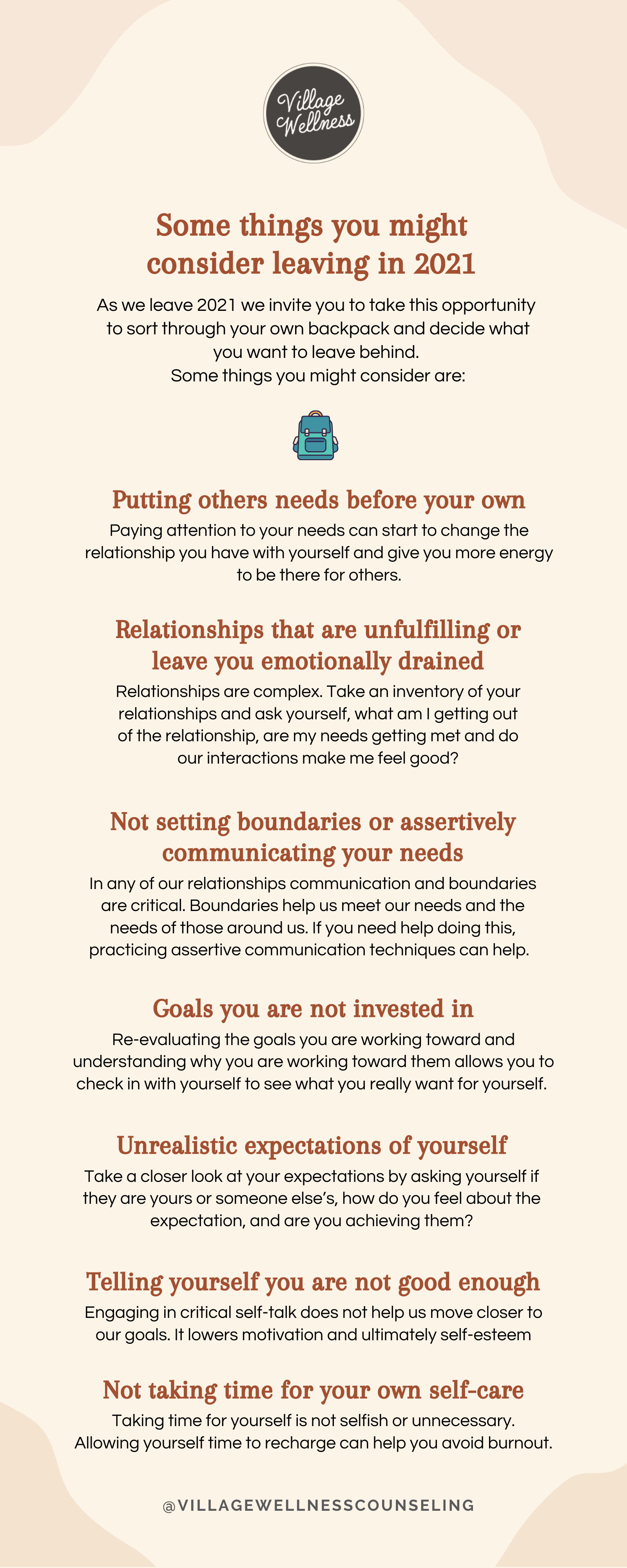
Unrealistic expectations of yourself – Having expectations of ourselves can be a way to keep ourselves accountable. Checking your expectations to ensure that they are reasonable and attainable is important. Take a closer look at your expectations by asking yourself if they are yours or someone else’s, how do you feel about the expectation, and are you achieving them? If you feel poorly or are regularly not meeting them, see if you can identify why or what is getting in the way. This may open the door to re-evaluate how and why the expectations develop and begin to assess whether the expectation is realistic.
Telling yourself you are not good enough – Engaging in negative and/or critical self-talk generally does not help us move closer to our goals. While some may say that this way of thinking is motivating, it is generally the opposite and can lower motivation and ultimately self-esteem. Finding ways to be more constructive and self-compassionate in the way you talk to and think about yourself can help you move toward your goals and help you feel better about yourself and your relationships.
Not taking time for your own self-care – Often being too busy, not feeling like you can, or that you don’t need it are reasons people give for not taking time for self-care. However, taking time for yourself is critical. It is not selfish or unnecessary. Allowing yourself time to rest and recharge can help you avoid burnout. It’s also an act of loving yourself.
Everyone’s experiences are different, as are our needs. Imagine how it might feel if what you carried with you felt a little lighter. What do you want to carry in your backpack?

 Village Wellness Family Counseling, P.C. – Blog