
How to make your holidays better
The holiday season is upon us. The time of year where people gather with family and friends to celebrate and spend time together. While this can be fun-filled and joyous for some, for others quite the opposite. Holiday celebrations can bring up feelings of anxiety, apprehension, dread, awkwardness, and/or discomfort. You might be bringing together two sides of the family and are unsure how this will go. Or seeing the family member(s) that tends to criticize or question everything, or someone that over indulges with alcohol. You could be seeing people who have drastically different viewpoints and argue over the differences, or maybe you are going to a gathering and meeting people for the very first time. You may also be in a room with someone you feel uncomfortable around. Any of these situations, as well as countless others, can feel overwhelming and you may be struggling to figure out how you will get through it.
Here are a few tips to help you make your own holiday survival guide and ways to communicate your boundaries.
Identify and make your needs a priority.
Making other people happy around the holidays is common but asking yourself what would help you enjoy the holiday is also important. You deserve to enjoy where and how you spend your time.
Ask questions.
Before committing to an event, get information about it. Think about asking, who, what when, and where. Who will be there, what will we be doing, when is it starting and ending, and where is it taking place? The answers to these questions might help you decide if you want to attend. Keep in my people will be themselves in most situations. Be honest with yourself about how you feel about the attendee list and their behaviors.
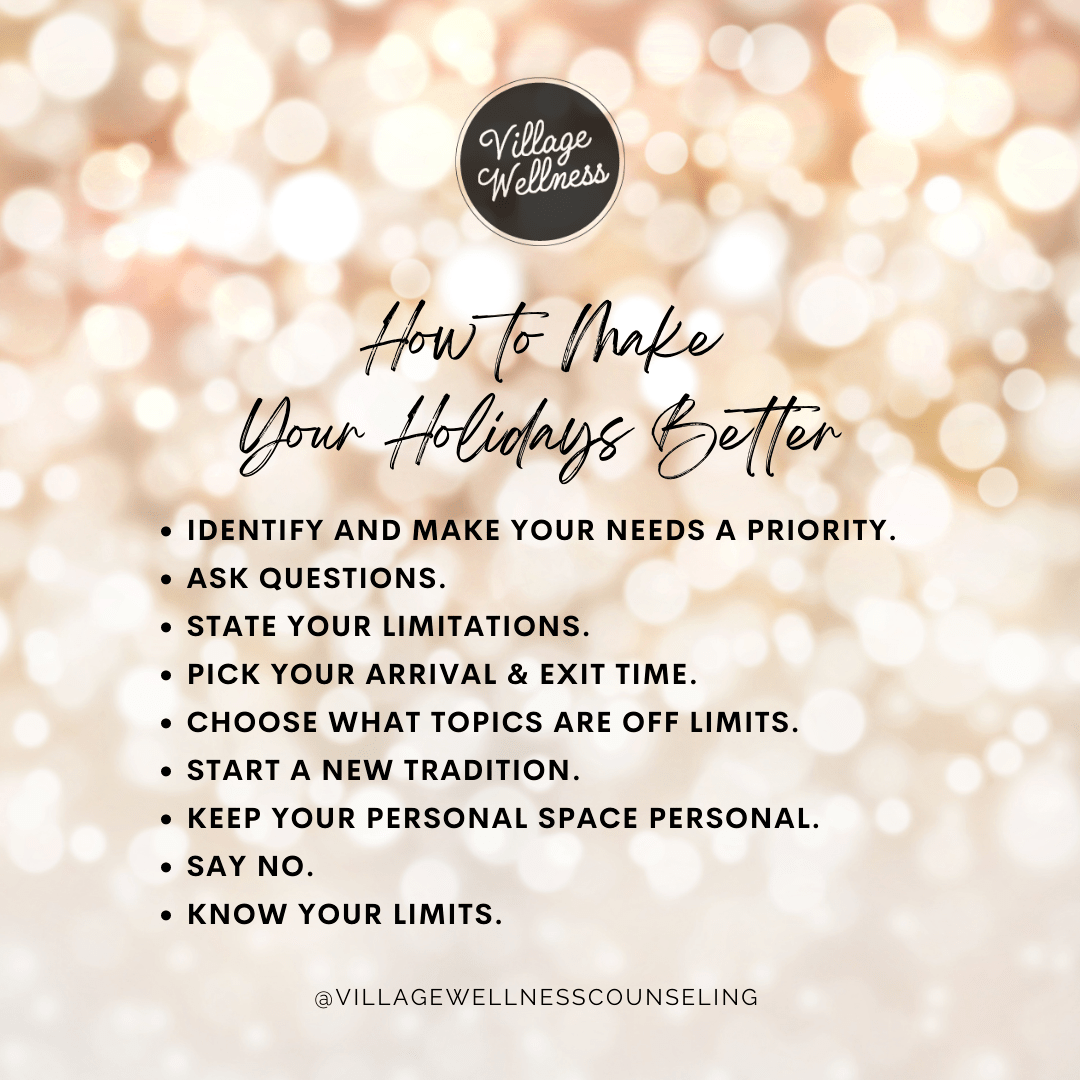
State your limitations.
Many times, there are expectations about what we will be doing or bringing to an event. It could be related to bringing a food item or spending time with certain people. For example, “I can bring a side dish and/or a dessert but that’s all I can commit to bringing.” “I enjoy seeing family but I can’t be responsible for entertaining them.”
Pick your arrival & exit time.
Make a plan to arrive and/or leave at a specific time and communicate that with your host or people you are going with. This may mean you drive yourself instead of riding with other people. “I am looking forward to coming but I won’t be there until _____” or “I’ll be there but have to leave at _____” or “I can only stay a for two hours.”
Choose what topics are off limits.
You are allowed to decide what conversations you feel comfortable having and with whom. Figure out what you do not want to discuss. Prepare responses to questions or topics that are off limits for you. It might sound like “This is a very hot topic with a lot of different opinions. Let’s talk about something different instead” or “When/if I will be having children is not something I will talk about. Thank you for respecting that.”
Start a new tradition.
If some of the traditions of the day aren’t ones that you enjoy, start a new one. This might look like bringing a board game or suggesting an outdoor activity. You can also elect to not participate in an activity if you don’t feel comfortable.
Keep your personal space personal.
Just because people are family or close friends does not mean they are automatically allowed in your personal space. Sometimes body language is enough to keep people at a comfortable distance. For example, you could put your hand out to shake hands with someone to ward off a hug or stand with your arms crossed. Whether it is with people you know or people you don’t communicate your level of comfort. Perhaps saying, “I’m not comfortable with hugging right now. Thank you for understanding.” Also, the concept of physical distancing is well known and can make it easier to ask someone to step back or for you to take a step back by saying, “I feel more comfortable with a little more space between us.”
Say no.
It’s okay to say no to an invitation, even if it comes from family. And while you may choose to explain why, you do not have to justify your decision to anyone. If you genuinely want to, offer an alternative. This can sound like, “Thank you for inviting me but I won’t be able to make it,” “I’m won’t be able to make it, but I would love to meet for coffee or dinner another time.”
Know your limits.
When the day arrives, give yourself the space to change your mind and set new boundaries. People are unpredictable and allowing yourself to be flexible and reevaluate how you feel and what you need is important.

 Village Wellness Family Counseling, P.C. – Blog