
Living With Anxiety – The Effects of a Missed Childhood Diagnosis
Growing up many adults around me believed that children did not suffer from anxiety, instead, they were considered shy. I was one of those kids. Anxiety gripped me so hard that I suffered from daily stomach aches and headaches. One was attributed to “weak eye muscles” and the other to “food not agreeing with me.”
For years I did these eye exercises and drank Pepto Bismol. Nothing seemed to work which meant, to my parents, that I wasn’t trying hard enough. My parents were only following the pediatrician’s guidance; however, it made life very difficult and I am just now understanding how much I missed out on.
“Growing up many adults around me believed that children did not suffer from anxiety, instead, they were considered shy. I was one of those kids. Anxiety gripped me so hard that I suffered from daily stomach aches and headaches.”
At the age of 12, I was taken to the doctor where I was diagnosed with an ulcer. While the doctor told my dad this was uncommon and it appeared I was suffering from anxiety my dad took the prescription, ignored the doctor, and we were on our way. Nothing was ever mentioned regarding the headaches and so my dad continued to give me Tylenol, sometimes 4 or 5 at a time, to manage them. To my surprise my dad did schedule a therapy session a year later but it was for the entire family. When my stepmom didn’t like what was being said she refused to continue and I was left to go alone. I will never forget his first question to me when we were alone, “So how are you doing?” I responded with, “Fine.” And the last thing I remember from that last session was drawing while he asked me, “Define fine for me.”
In school I avoided speaking, especially in front of the class. On 1 occasion I wasn’t able to avoid public speaking and so I took some deep breaths and walked to the podium. I was so proud of myself for getting through the 2 minute presentation and then came the teacher’s comments. “Could anyone hear what Kandi was saying?” Most of the kids raised their hand agreeing they were able to hear me and that’s when the teacher asked, “How was that possible with her tapping her foot so loudly?” I was mortified! I turned to walk back to my seat as tears welled up in my eyes and was told I needed to stand there and listen to the critiques because how else was I going to learn? I didn’t do any public speaking again until college, 10 years later. And so it went throughout school, I was the shy girl.
During this time I also developed an alarming case of psoriasis. I had shown it to my dad and was handed some lotion. It began to creep out of my hairline and down my forehead. I was finally able to convince my dad the lotion wasn’t working and I needed to see a doctor. Doctors are trained to not make any facial expressions so they don’t alarm the patient, he was not able to do that. As he assessed my condition he lectured my dad and told him he could give me medicine to clear it up; however, it was obvious to him that I was clearly suffering from anxiety and needed to be seen by a therapist immediately. My dad thanked him, took the prescription, and therapy wasn’t mentioned again.
Despite these clear somatic symptoms screaming to anyone who would listen, my anxiety was not addressed until I was in my 30’s. I will often ask a client, “Where do you feel anxiety in your body?” Or “What does your body feel like when you are anxious?” I am typically met with, “What do you mean?” Had I been asked that same question I imagine my response would have been the same, yes I was shy and I still am to some degree but for all intents and purposes I appeared to be a typical girl with typical middle and high school angst. To an outsider I appeared to be a typical teenager.
I had become really good at doing what I needed to do and spoke little about my anxiety, if at all. If it ever came up I was met with, “Oh you’ll be fine. It’s no big deal.” Over time as people would see me struggle nothing was ever said.
This cannot be sustained over time and that’s when I had my first panic attack. My husband and I were on the freeway when I started feeling like I couldn’t breathe. A horrible pain ran down my arm. I started to feel dizzy and then I spotted the hospital and begged him to take me there because I knew I was dying. His refusal only upset me more and in our moving car I reached for the door handle ready to jump out and do what it took to get to the hospital. He grabbed my arm, pulled over, and said, “Calm down! You’re just having a panic attack.” I was 20 years old and had no idea what he was talking about. This would not be my last panic attack.
Over time I went to see several doctors and therapists. Doctors gave me medication that rarely helped and therapists just talked to me but didn’t give me any tools to help me manage my anxiety. And again time went on and I began to manage my anxiety by chewing on the inside of my lip or biting around my finger nails. When my husband would see me doing this his response was always, “Quit eating yourself.” Trying to shame me was not helpful and only made me feel worse.
My husband and I separated and I began therapy, again. This therapist showed me empathy, shared with me some of his struggles and what helped him. He gave me the tools and resources I had always needed and wanted but didn’t know they were out there or how to ask for them. He explained that not all techniques work for all people; however, I could find what worked for me. My search began.
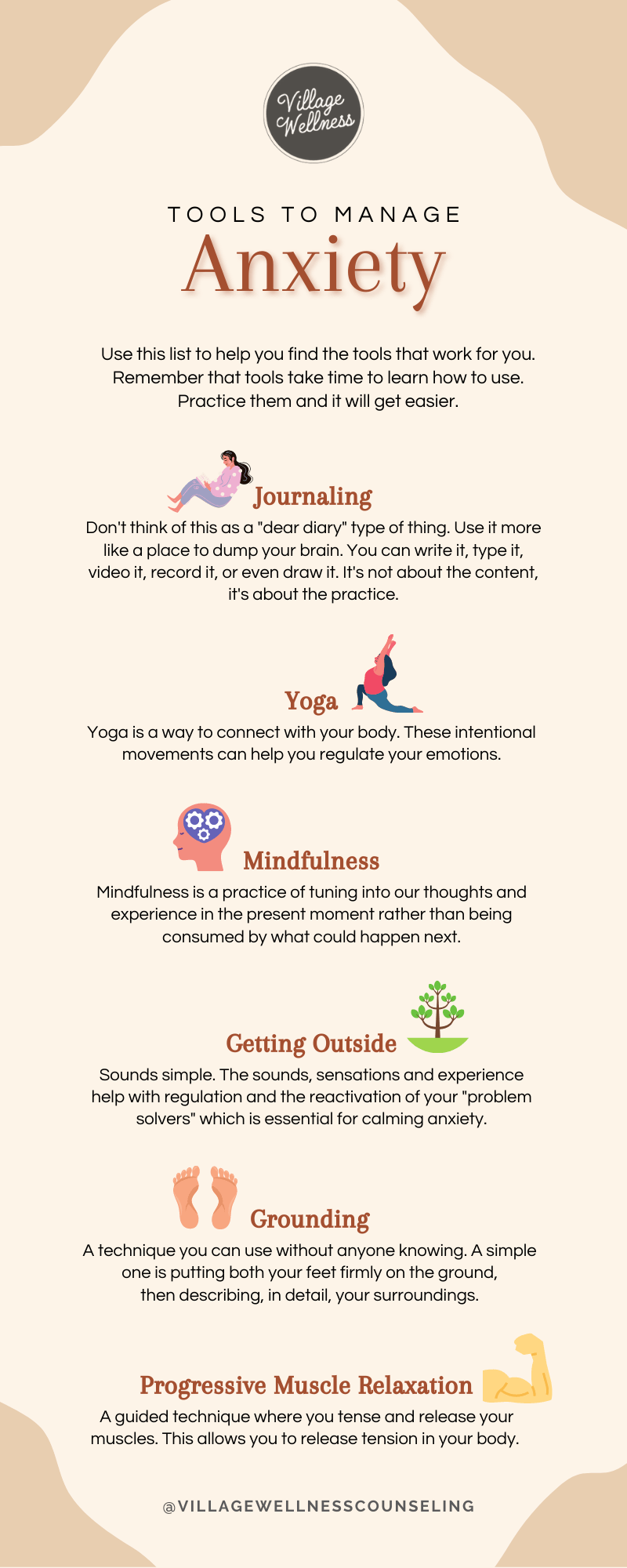
Journaling – made me angry
Yoga – felt relaxed regardless of the time of day that I did it
Mindfulness – at the time it wasn’t properly taught to me, however I practice it often now
Getting outside – that sounds so simple however when you are feeling anxious it may not always be helpful but it is for some
Meditation – at the time it seemed very difficult but again as I learned more about it I was able to use it with some success
Grounding – extremely useful and something I could do without anyone noticing
Progressive Muscle Relaxation – another technique I found helpful because I was able to finally pinpoint where I held my anxiety in my body
And then I was told to breathe. I thought, “But I breathe all the time, how is that going to help me?” It’s so simple. I began using it, but found it wasn’t as helpful as I had originally thought it would be. The turning point came when I began teaching the families I worked with how to do it and I realized it’s a skill not a magic pill. With most skills when we practice them on a daily basis we become better over time and that is what happened. For me one of the best things about it is that everyone breathes. No one would know I was using my new coping skill and that’s what I wanted.
Breathing – 4 slow breaths in, hold for 4, exhale slowly for 4, hold for 4, repeat…
Just because some of the techniques didn’t work for me or I didn’t like them doesn’t mean they don’t work. It’s about finding what works for you.
“Learning to live with anxiety means that I’m always having to adjust to what I need and when. It’s not perfect, it’s practice.”
Having supportive friends and family is also extremely helpful so that you don’t feel alone and that is something else I have created for myself.
Some other tools that have worked for my clients and myself are the following: Worry Breath (app), Mindful Powers (app), Anxiety Log (app), and Rewire Your Anxious Brain (book and free audiobook).
Learning to live with anxiety means that I’m always having to adjust to what I need and when. It’s not perfect, it’s practice.

 Village Wellness Family Counseling, P.C. – Blog