
How to find the therapist that’s right for you
Deciding to go to therapy is a big decision. It takes a lot of courage to take this step and may be fraught with uncertainty and fear. A quick search on Google, sites for therapists, or a list from an insurance company might result in hundreds of providers. Just looking at the number of search results is overwhelming, there are so many choices! So, how do you actually choose a therapist?!
We’ve put together some information to make finding a therapist that’s right for you a little bit easier.
Narrow down your search
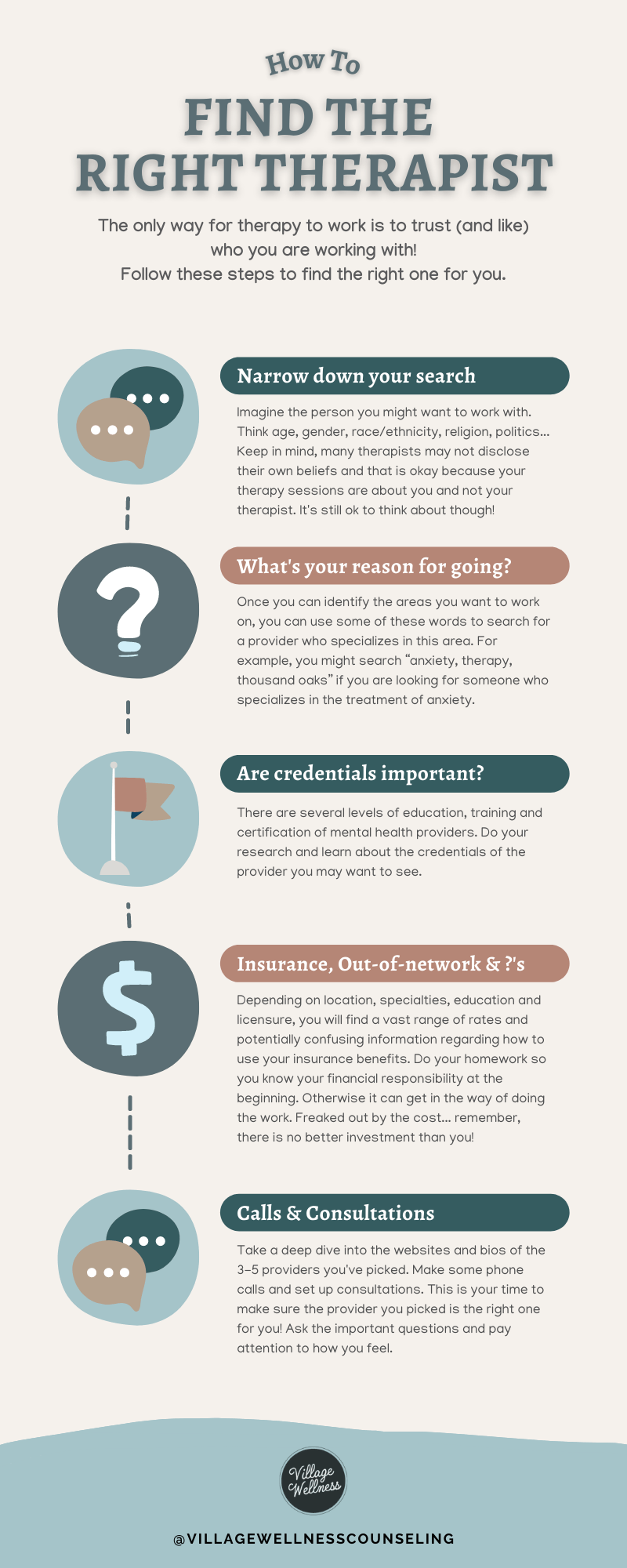
Imagine the person you might want to work with. Do you imagine that person to be of a specific age, race/ethnicity, or gender? These are all important factors to reflect about. Ask yourself how important is the age of the person you are working with? Would you feel more comfortable talking with a male, female, or someone who is non-binary? What would it be like for you to work with someone of the same race or ethnicity or someone who is a different race or ethnicity? Are you looking for someone who holds specific religious or political beliefs? Keep in mind, many therapists may not disclose their own beliefs and that’s okay because your therapy sessions are about you and not your therapist.
what’s your reason for going?
Difficulty managing feelings of anxiety or having intrusive thoughts? Problems in your relationships? Work related stress? Lack of motivation or feeling down or sad? Struggling to manage emotions? Fear holding you back in life? Difficulty processing a traumatic experience? Once you can identify the areas you want to work on, you can use some of these words to search for a provider who specializes in this area. For example, you might search “anxiety, therapy, thousand oaks” if you are looking for someone who specializes in the treatment of anxiety.
Are credentials important?
Some therapists, such as a Marriage and Family Therapist (MFT) or Licensed Clinical Social Worker (LCSW), have completed a Masters’ degree (generally a minimum of a 2- year program) in addition to completing the training hours requirement and taking state licensing examination(s).
A psychologist (Psy.D. or Ph.D.) has completed a doctorate degree (a 4–5-year program) as well as training hours requirement including an internship, post-doctoral training, and state licensing examinations.
An trainee is still working on completing their degree program. They are supervised by their graduate program and a supervisor at their practicum site. An associate has completed their degree program, registered with the state, and is supervised by a licensed clinician
Some clinicians may also hold certifications for specific specialties that may be important to you.
These are considerations that can help you hone your list.
The best investment
When it comes to finding a therapist an important decision may be if they are in-network with your insurance company or out-of-network. Depending on location, specialties, education and licensure, you will find a vast range of rates and potentially confusing information regarding how to use your insurance benefits. Here are some simple tips to help you navigate this.
In-network benefits: This means that the provider has a contract with your insurance company for a specified rate. Your provider bills your insurance company directly and you are responsible for your co-pay or payment towards your deductible.
Out-of-network: Most PPO insurance plans include out-of-network benefits, which means you get the greatest flexibility in choosing your provider. An out-of-network provider will either give you a superbill (a document with information to submit to your insurance company) or will submit a courtesy out-of-network claim after you’ve paid for your services.
If you’re still feeling a little lost in navigating insurance, read our blog post on navigating your out-of-network benefits for therapy.
narrow it way down
To continue to narrow down your list to find your therapist, the websites and biographies for each person can be wealth of information. This is your first introduction to a therapist. The website and bio gives a snapshot about who the therapist works with, provides some insight on how the therapist works with their clients, and most provide a photo of the therapist themselves. Narrow your list down to 3-5 therapists and give them a call!
The consultation
Frequently, providers offer a free consultation for the specific purpose of helping prospective clients gather information to find the right provider for them. A consultation is an opportunity for you to share what you want help with. Think of it as an interview (you are interviewing them). Use this as your opportunity to get to know the therapist’s style and potential approach to the issues you are experiencing. It also helps the therapist assess if they have the skill set and/or training and experience to help as you work toward your goals (by the way, a sign of a great therapist is one who gives you a referral to someone else if they don’t think they are the right fit for you).
During the consultation, pay attention to how you feel talking to the therapist. Some feelings of anxiety and uncertainty are to be expected. But overall, do you feel comfortable with the therapist’s responses to your questions? Can you see yourself being able to talk with this person about the things that are going on in your life? While training and experiencing is important for a therapist to have, one of the most influential factors in the therapy process is the therapeutic relationship. This will grow over time, but if you’re not comfortable with your therapist it could lead you to hold back in session and delay achievement of your goals.
Remeber, making the decision to start therapy is significant and finding someone who you feel is a good fit is the priority. You’ve got this!

 Village Wellness Family Counseling, P.C. – Blog